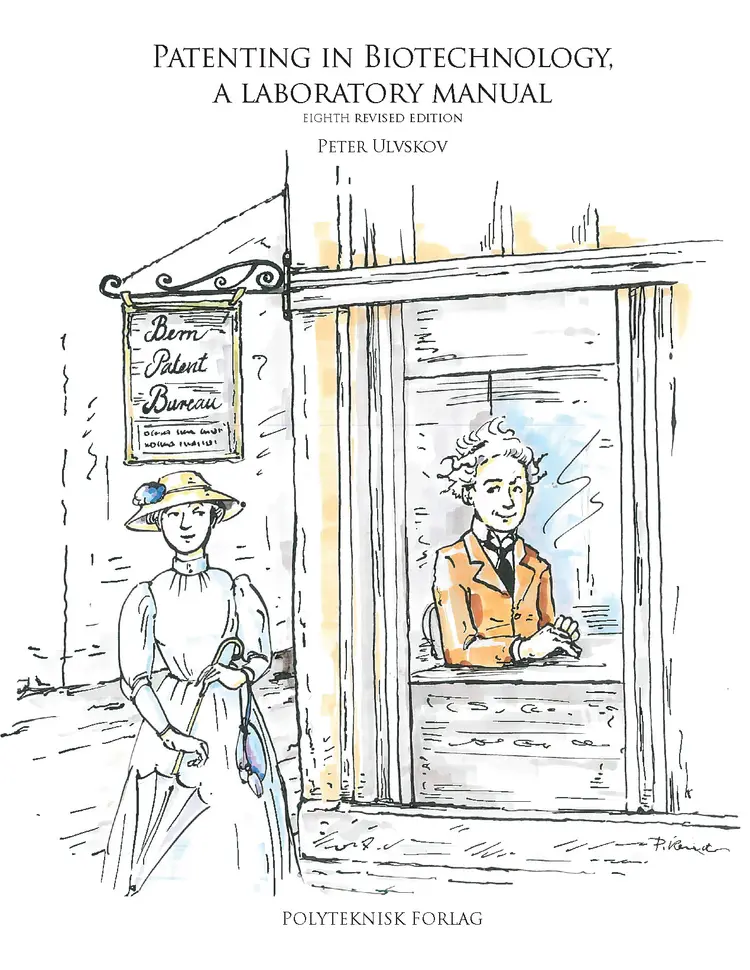
Patenting in Biotechnology, a laboratory manual is a down-to-earth approach to teaching intellectual property rights in biotechnology.
It covers the bare essentials of intellectual property rights that the biotechnologist needs and nothing more. Focus is on practical skills: how to search for patents and applications, follow application through the patenting system in Europe and the USA; and how to read and analyze patents, which hopefully will lead to writing better patent applications.
Contents
1 Introduction to IPR
1.1 What are patents?
1.2 Excluded from patenting
1.3 Novelty
1.4 Inventive step
1.5 Industrial applicability
1.6 Enablement and clarity
2 Institutions and agreements
2.1 Paris Convention (1884)
2.2 TRIPs (1994) and PLT (2000)
2.3 Budapest Treaty (1977)
2.4 Patent Co-operation Treaty (1978), PCT
2.5 European Patent Convention (1973)
2.6 Patent Prosecution Highway (2008)
2.7 fiveIPoffices IP5 (2013)
2.8 UPOV (1961)
2.9 Nagoya Protocol (2010)
2.10 National differences
2.10.1 First to invent
2.10.2 Grace period
2.10.3 Disclosure of prior art
2.10.4 Medical treatment
2.10.5 Plants and animals
2.10.6 Anything under the sun invented by man
3 The patent document, filing, and examination
3.1 PCT filing
3.1.1 Publication and Search Report
3.2 EP filing
3.3 USPTO-filing
3.3.1 Document types of the US system
4 The Patent family
4.1 The European Patent Register
4.2 Patent tree examples
5 Patent search
5.1 The Derwent Innovations Index
5.1.1 The hierarchical search profile
5.1.2 International Patent Classification codes
5.1.3 Derwent Manual Codes
5.2 Searching patent descriptions
5.2.1 Full-text searching in USPTO
5.2.2 Full-text searching in Patentscope
5.3 Searching based on sequence information
5.4 Searching based on chemical structure
5.4.1 Derwent Chemical Resource
5.4.2 SciFinder
5.4.3 Patentscope
6 The Biotech patent
6.1 Claims
6.1.1 Types of claims
6.1.2 Claims on low-molecular weight compounds
6.1.3 Claims on genes and proteins
6.1.4 Claims on pharmaceuticals
6.2 Definitions
6.3 Strength of a patent
6.4 Biotechnology near the borderline of patent law
6.4.1 Diagnostics and inventions
6.4.2 Engineering the human germ line
6.4.3 Oliver Brüstle versus Greenpeace
7 Epilogue